


US credit cards for non-residents: the complete guide
How non-US residents get US credit cards and US credit, the right order to do it in, and how to get the most value out of the offers. Updated for 2026.
By Chris Natterer · Published June 11, 2026
US credit cards beat the German and European offers on most of the things that matter. The sign-up bonuses are far bigger, the points multipliers on spending are higher, and the perks are usually both more numerous and better.
Almost nobody realizes you can use these offers as a non-US citizen and non-resident. That’s exactly what this guide is about. I’ll show you how to get a US credit card as a non-resident, what the right order is, and how to pull the most value out of the offers in the end.
Where the advantage comes from
The difference has a simple cause: a fee running in the background.
When you pay by card, the merchant pays a fee called interchange. In the EU, regulation caps that fee at 0.30 percent. In the US, depending on the card, it sits around 1.8 to 3.3 percent. Banks fund their rewards out of that gap. So US cards simply have six to seven times the budget for points, miles, and bonuses. That’s why Europe has no sign-up bonuses in the range of 60,000 to 125,000 points and the US does.
What that’s worth in practice: a sign-up bonus of 75,000 points is roughly enough, used well, for a business-class flight from the US to Western Europe. The cash price of a ticket like that quickly runs to 3,000 to 6,000 dollars. Shorter economy routes start at around 12,000 points. On top of that come lounge access, hotel and travel credits, and status with airlines and hotel chains.
That’s the real appeal. A single US card with a good bonus can replace a long-haul flight you’d otherwise have paid a lot for. If you travel a lot, you pull real value out of this over the years. If you barely fly, the whole effort is wasted. We come back to that distinction at the end.
The key distinction: getting a card vs. building credit
This is the most important mistake almost every guide glosses over. There are two completely different goals, and they get mixed up constantly:
- Getting any US card in your hand. That works relatively fast for many people, and through one specific route it can happen in a few weeks.
- Being seen as creditworthy in the US. That’s the real key to the good cards with the big bonuses, and it takes months.
In the US, everyone has a credit score, the FICO score. It’s built from your credit history: whether you pay on time, how long you’ve held accounts, how many inquiries there have been. If you’re new to the system, you have no history. They call it “credit invisible.” You’re not rated badly, you simply don’t exist as far as the banks are concerned.
Getting a first card starts that history. But a meaningful score needs at least six months of reported payments, realistically more like six to twelve months, before you reach the genuinely attractive cards. Any guide that promises “score 700 in five weeks” ignores how the system works.
Hold on to this distinction. The rest of the guide follows it.
SSN, ITIN, and EIN: three numbers people constantly confuse
Before we get to the routes, three terms, because most of the confusion hangs on them.
- SSN (Social Security Number). The personal tax and social-security number for US citizens and certain residents. As a non-resident you generally don’t get one.
- ITIN (Individual Taxpayer Identification Number). The tax number for people who can’t get an SSN but have a US tax obligation. You can apply for an ITIN. On personal credit cards, the ITIN replaces the SSN. Seven of the ten largest US card issuers accept an ITIN, including Capital One, Bank of America, Citi, Chase, U.S. Bank, American Express, and Synchrony. Important: ITIN accepted does not mean ITIN approved. Without history you’re still credit invisible at first.
- EIN (Employer Identification Number). The tax number for your company, meaning your US LLC. It’s a company ID, not a personal one. The EIN alone won’t get you a personal credit card. It is, however, the key to certain business cards, more on that below.
The most common false claim online is that the EIN bypasses the SSN and ITIN entirely, so you can just get personal cards through the company without a personal tax number. That isn’t true. The company and the person are separate. I cover the details in ITIN, SSN, and EIN.
The routes to a first card
There are essentially three entry points. They don’t rule each other out, they combine.
Route 1: Amex Global Transfer
The fastest and most reliable route if you already have an American Express card in your home country. American Express is a global company and lets existing customers apply for a US card through its Global Card Relationship, with no US credit history and no SSN.
The requirements in detail:
- A home Amex that’s been running for at least three months.
- A real US address, not a pure mailbox or maildrop address.
- A US bank account.
- A valid passport is enough for identification.
The limit of this route: it gets you exactly one card. And at first it produces only a thin history, a “thin file.” So Amex Global Transfer is an excellent door-opener, but not a finished score. American Express can also, in individual cases, request a tax transcript (Form 4506) when the details are checked. The full process is in Amex Global Transfer step by step.
Route 2: secured card or authorized user
The classic route for building history if you don’t have an Amex or want more than one card.
- Secured card. A card against a deposit. You put down, say, 500 dollars and get a matching credit limit. Every on-time payment is reported to the bureaus and builds your score. Issuers that work for getting started without an SSN include Capital One (secured), Firstcard, Self, and Petal.
- Authorized user. You get added to the card of someone with good US history as an additional cardholder. Their history can feed into your score. That assumes such a person exists and trusts you.
Both routes are unspectacular, but they’re the real foundation. After six to twelve months of clean history, the unsecured cards with the big bonuses open up. A realistic month-by-month timeline is in building a US credit score from zero.
Route 3: EIN-only business cards through the LLC
If you have a US LLC with some substance, there are business cards that ask only for the EIN and no personal guarantee.
- Brex, Ramp, and similar. These cards run purely on the company, with no personal guarantee. In return they want to see substance, such as a minimum cash balance (in Brex’s case, in the range of 50,000 dollars) or funding. The key point: these cards build no personal credit. They help the company, not your personal score.
- Classic bank business cards like Amex Business or Chase Ink require a personal guarantee, and therefore an SSN or ITIN. You’re personally on the hook.
That’s the resolution of the EIN myth. A card purely through the company without a personal number does exist, but it demands substance and does nothing for your personal score. More in the dedicated piece on US business credit cards.
The realistic path, step by step
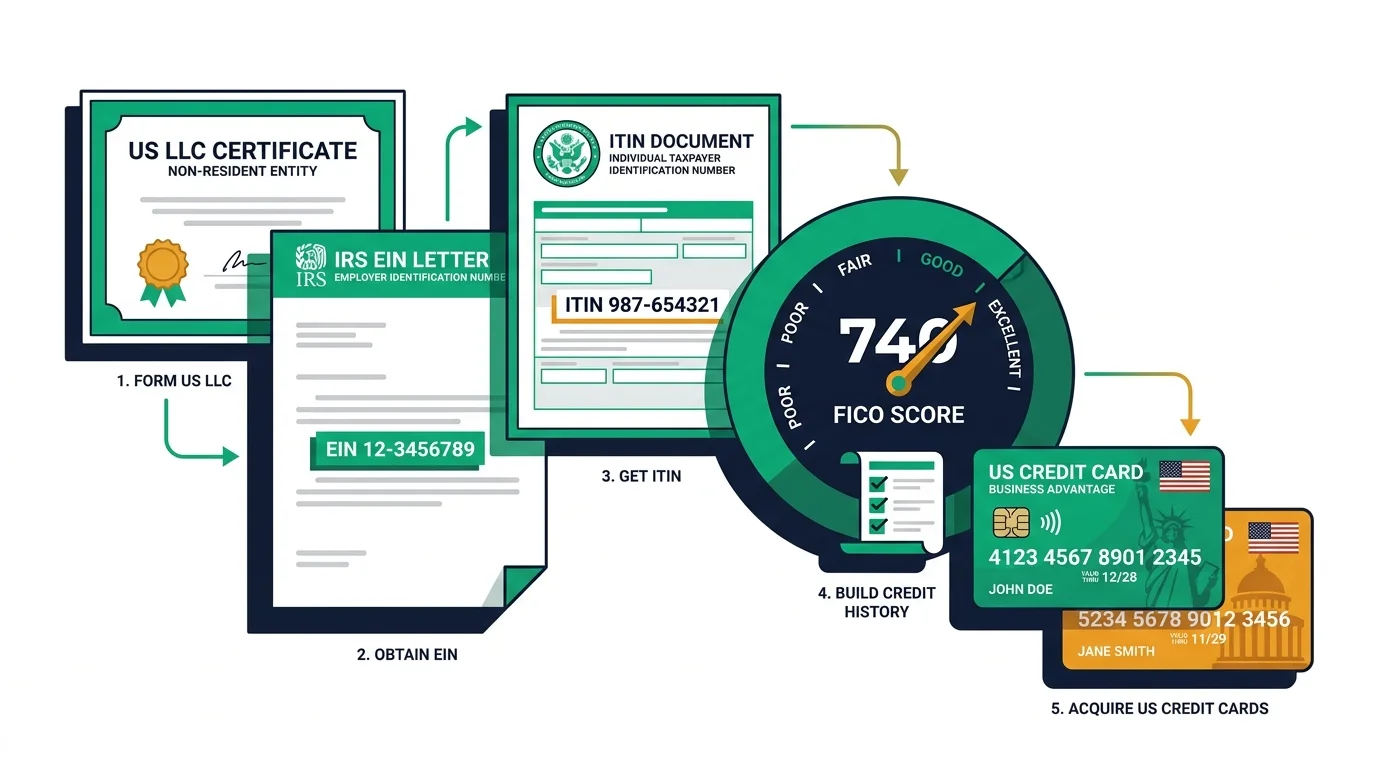
Put the pieces together and a clear path emerges. This is also where the connection to the US LLC sits, which is why this topic isn’t a detour for many of my readers, it hangs directly off what they’re already doing.
- Form a US LLC. It’s the base that produces a business account, an EIN, and a US business address.
- Apply for the EIN. The company tax number, the prerequisite for the account and for business cards.
- Open a US bank account. Needed for Global Transfer and for ongoing payments.
- Use Amex Global Transfer if you have a home Amex. That gets you the first real US card quickly.
- Apply for an ITIN. If you run a US LLC, the obligation to file Form 5472 usually gives you a clean reason to apply for one. With the ITIN, the personal cards open up.
- Build history through a secured card or authorized user. Six to twelve months, on time.
- Apply for unsecured cards with bonuses once the score holds. From here the actual points-and-miles collecting begins.
The order isn’t an accident. Each step unlocks the next. Anyone who jumps in mid-way, say without a US address or without history demanding a premium card straight away, fails predictably.
The requirement people fail on most: the address
When an application gets rejected, surprisingly often it isn’t the score, it’s the address. This is the single most important practical point in the whole topic.
US banks recognize commercial mailbox addresses (in the jargon, CMRA, Commercial Mail Receiving Agency) and pure maildrop services. Many reject applications with those addresses automatically. You need a US address that passes as a residential or business address and is consistent across every touchpoint: the same address at the IRS, at the bank, and on the card application.
That’s also why a properly set up business address through a registered agent is worth more than the cheapest maildrop service. The address isn’t a detail, it’s often the point where the whole plan lives or dies.
Risks, myths, and outdated tips
So you don’t walk into the usual traps that fill so many guides:
- Nova Credit and Amex. Services like Nova Credit or Credit Passport import foreign credit into the US. Important: the partnership between Nova Credit and American Express ended in 2025. Many older guides still recommend this route. It no longer works that way.
- Never run an SSN and ITIN in parallel. If you ever do get an SSN, the ITIN becomes invalid. Using two numbers side by side creates chaos in your credit file.
- Chase 5/24. Chase rejects applications if you’ve opened five or more new cards in the last 24 months. Collect cards too fast and you lock yourself out.
- Hard credit inquiries dent your score short-term. Every application costs a few points. Apply deliberately.
- Account closures. Banks, American Express in particular, can close accounts with little warning if behavior looks suspicious. Stay clean and consistent.
- Manufactured spending. Artificially generating spending to hit bonuses is risky and gets you shut down fast. Stay away from it.
This list isn’t here to scare you. It’s here because the people who only show the wins leave exactly these points out.
Is the whole effort worth it?
That depends on you.
It’s worth it if you already run or plan to form a US LLC, travel internationally on a regular basis, and are willing to put a few months of patience into the build. Then a US card isn’t an exotic trick, it’s a logical building block on a structure you already have. The payoff in flights, lounges, and status is real and repeats year after year.
It’s not worth it if you rarely fly, have no US structure and don’t want to build one, or if you’re hoping to skip the history-building and grab the big bonuses immediately. Then you pay a lot of effort for little return and end up annoyed by annual fees you can’t use.
Whether the points-and-miles game adds up in detail is in is travel hacking worth it. Which cards actually come into question is compared in the best US credit cards, and whether the pricey Amex Platinum pays off has its own piece.
How I help with this
My part isn’t the credit card itself, it’s the infrastructure underneath that decides between approval and rejection: the US LLC cleanly formed, the EIN applied for, the ITIN correctly filed, a bank-grade address, and the ongoing compliance handled.
If you want to know whether this path fits your situation, read through the individual steps first. If you want to set up the infrastructure underneath, the service pages are your entry point.
The key points
- US cards offer more rewards than European ones because merchant fees in the US are higher.
- Separate two things: getting a card (often fast) and becoming creditworthy in the US (six to twelve months).
- The ITIN replaces the SSN on personal cards. The EIN is the company number and does nothing for your personal score.
- The fastest door-opener is Amex Global Transfer, if you have a home Amex. But it stays at one card.
- The most common reason for rejection is the address. Mailbox addresses get recognized and rejected.
- It’s worth it mainly for frequent travelers with a US structure. For everyone else the effort outweighs the return.
This article explains the basics and is not legal, tax, or financial advice. Individual banks’ rules change constantly. Check the current terms before you apply.

Written by Chris Natterer
Founder of Globalization Guide, helping international entrepreneurs form and manage US companies since 2019.