


Malta residency: non-dom remittance, the 15% status, and what to settle first
Malta for people with foreign income: the resident non-dom remittance basis, the EUR 5,000 minimum tax, the 15% TRP status, EU residency, and the home-country exit. Updated 2026.
By Chris Natterer · Last updated June 22, 2026
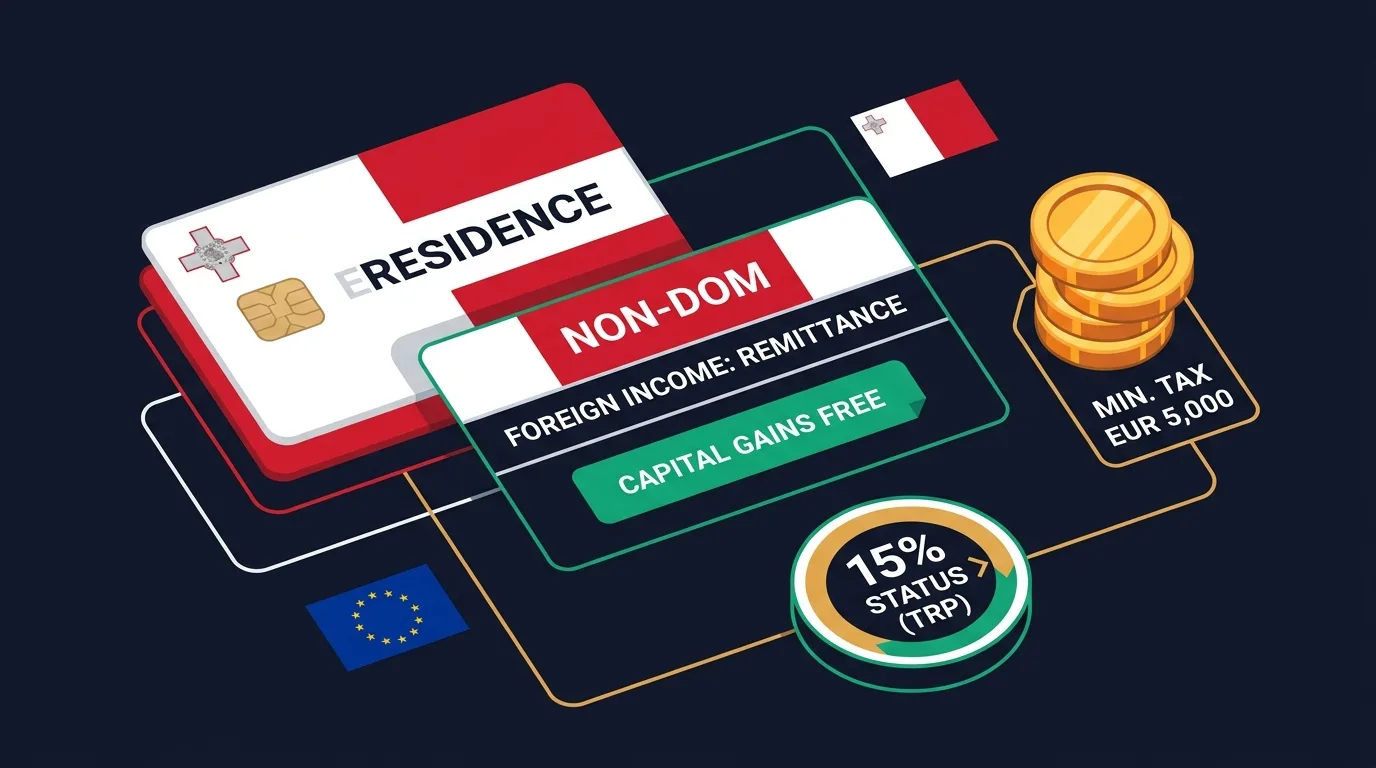
This guide covers Malta as a residence for an individual with foreign income: the two tax models the country offers, what is actually tax-free and what is not, how you move there as an EU or Swiss citizen, and what to settle before you go. It is about you as a person living off your income, not the Maltese company.
Two models, not one
Malta is unlike Cyprus because there are two different routes for newcomers, and they get mixed up.
- The non-dom remittance basis. The default for someone resident in Malta but not domiciled there: foreign income is taxable only as far as you bring it into Malta.
- The 15% status (The Residence Programme, TRP). A voluntary special programme: a flat 15% on foreign income remitted to Malta, against a higher minimum tax and a property requirement.
Model 1: the non-dom remittance basis
If you are resident in Malta but not domiciled there, the logic is simple:
- Maltese income is taxed in full.
- Foreign income is taxed only as far as you remit it to Malta.
- Foreign capital gains are not taxed at all, even if you bring them to Malta.
The catch is a minimum tax of EUR 5,000 per year, which applies once a non-dom has at least EUR 35,000 of foreign income not fully remitted. Maltese tax already withheld counts toward it, computed before treaty relief. So the EUR 5,000 is a floor, not a surcharge. Malta is therefore not "tax-free" for an individual; it is remittance-limited with a EUR 5,000 floor.
Model 2: the 15% status (TRP)
For more predictability you can apply for The Residence Programme (TRP), the variant for EU, EEA, and Swiss nationals and so the right special status for most readers here:
- 15% flat rate on foreign income remitted to Malta.
- Minimum tax of EUR 15,000 per year.
- A property requirement: buy from EUR 275,000 (less in certain areas and on Gozo) or rent from EUR 9,600 a year.
- No Maltese employment.
The non-EU version is the Global Residence Programme (GRP), with the same 15% and EUR 15,000. The TRP suits you if you remit a lot to Malta anyway and want a fixed rate; keeping most foreign income abroad usually favours the plain non-dom basis and its lower minimum tax.
What else is taxed
Either way, income from work performed in Malta is taxed at the normal progressive rates up to 35% (the top rate above EUR 60,000; the tax-free band is roughly EUR 12,000 single / EUR 15,000 married). For the typical reader, earning from abroad rather than a Maltese job, this part is secondary.
Residency and the move
For DACH citizens the immigration step is the easy part. EU citizens register their stay (beyond three months) with the authority Identita and receive a free eResidence document, usually within weeks. Swiss citizens use EU-Switzerland free movement and are treated the same way. The investment-based programmes you read about, the Malta Permanent Residence Programme (MPRP) and the Nomad Residence Permit, are explicitly for non-EU nationals, so for most readers they are not the route.
What to settle before you move
A Maltese status does nothing while you are still tax resident at home. As long as you keep a home or habitual abode in Germany, Austria, or Switzerland, you remain taxable there on worldwide income. End the home-country residency cleanly first, then use Malta. For Germans, the extended limited tax liability (§2 of the Foreign Tax Act) can reach up to ten years after departure where substantial German economic ties remain, and a low-effective-tax Maltese setup can trigger that question. Malta does have double-tax treaties with Germany, Austria, and Switzerland.
Honest notes from practice
- Remittance is a matter of interpretation. Malta has few rigid rules on what counts as a remittance, so it only works cleanly with separate accounts and a local advisor.
- Banking is slow. Opening a Maltese account as a newcomer is notoriously KYC-heavy; budget weeks to months.
- Programme figures shift. The MPRP and special-status thresholds sit in subsidiary legislation and were last changed in 2024-2025; check the current figures before acting.
This is general information, not tax or legal advice. Rules on residence, remittance, and the special programmes change and depend on your facts; have your case reviewed before and after the move. Running your business through a US LLC alongside Malta? Learn about our formation services →

Written by Chris Natterer
Founder of Globalization Guide, helping international entrepreneurs form and manage US companies since 2019.