


Thailand residency: the DTV, the LTR, and the 2024 tax change
Thailand for people with foreign income: the DTV and LTR visas, the post-2024 remittance tax (Por. 161/162), what is still only a proposal, banking, and why Thailand is a place to live, not a second passport. Updated 2026.
By Chris Natterer · Last updated June 22, 2026
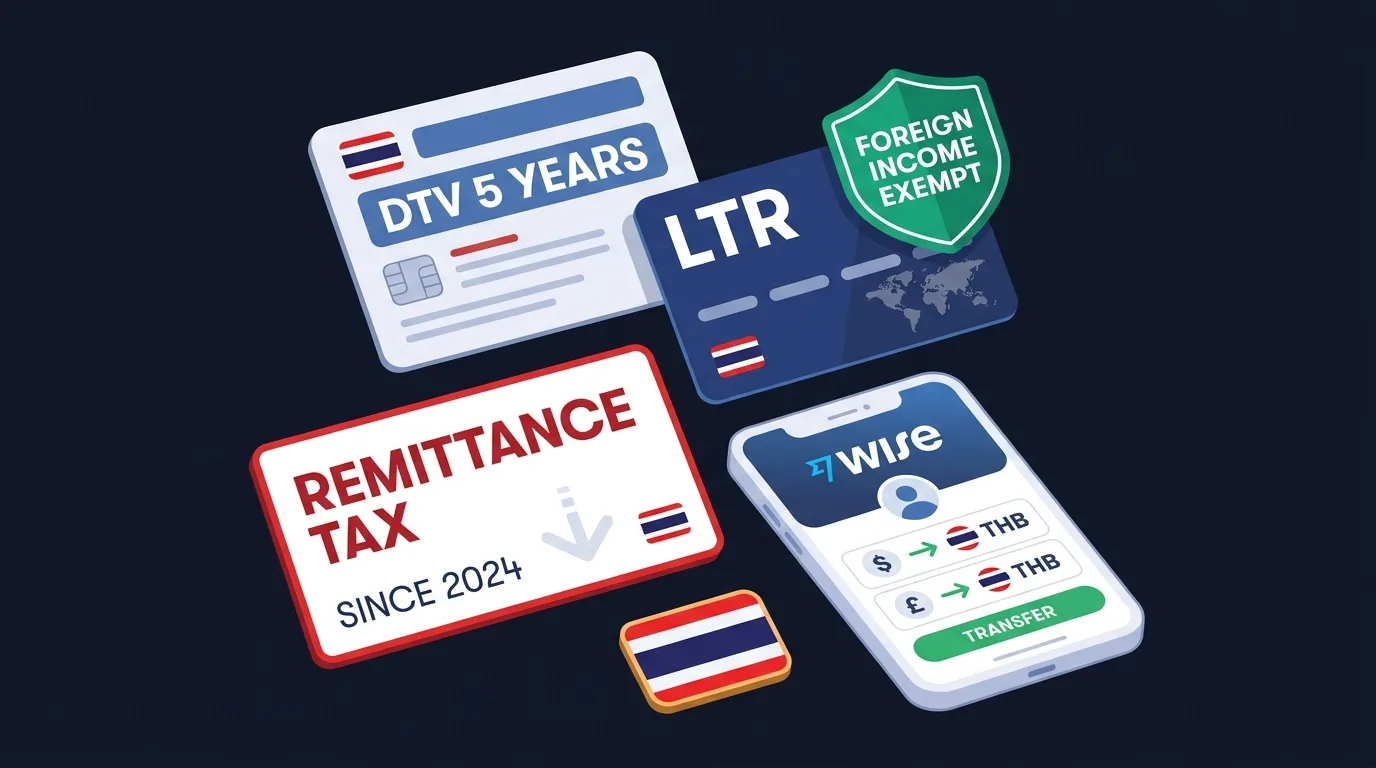
Thailand has long been a favorite for location-independent workers: low cost, good infrastructure, big communities in Bangkok and Chiang Mai. Tax used to be simple here, and that changed in 2024. This guide covers the current state for someone earning online or from abroad who wants to stay without a local job.
Visa options
DTV (Destination Thailand Visa, 2024)
The newer visa for remote workers and freelancers with foreign clients. Valid 5 years, multiple entry, 180 days per entry (extendable once by up to 180 days). Financial proof of about THB 500,000 (~EUR 14,000), and note that crypto, stocks, and pension funds are not accepted as that proof. It carries no work permit for local work and no tax benefit: spend 180+ days a year and you become a normal Thai tax resident.
LTR (Long-Term Resident, 10 years)
The premium visa, issued by the BOI, in four categories (Wealthy Global Citizen, Wealthy Pensioner, Work-from-Thailand Professional, Highly-Skilled). For three of the four, Royal Decree No. 743 grants a real exemption on qualifying foreign income, and the 2024 change does not override it. This is the one mainstream route to 0% Thai tax on foreign income. The Highly-Skilled category instead gets a 17% flat rate on Thai employment income.
Thailand Privilege (formerly Elite)
A paid membership visa for long stays without income or investment proof. Current tiers run from Bronze (THB 650,000, 5 years) up to Reserve. It grants residence, but no work permit and no tax benefit, a common misconception.
Retirement (Non-Immigrant O / O-A)
From age 50, with income or deposit proof (about THB 65,000/month or THB 800,000 on deposit). Renewable yearly, no work rights, no special tax exemption.
Tax: the 2024 change and what is still just a proposal
You are a Thai tax resident at 180+ days in a calendar year. Thailand does not tax worldwide income; it works on a remittance basis: foreign income is taxable when you bring it into Thailand. Money kept abroad is untouched. Rates run 0% to 35%.
The key change that dates older guides: until 2023, remitted foreign income was taxable only if remitted in the same year it was earned, so waiting a year made it tax-free. That loophole closed on 1 January 2024 (orders Por. 161/162): remitted foreign income is taxable regardless of the year earned.
Two things circulating that are not in force as of mid-2026, so do not plan around them: a draft to exempt foreign income remitted in the year earned or the following year, and a separate move to tax worldwide income. Neither is law. The LTR foreign-income exemption, by contrast, does stand.
Thailand has a double-tax treaty with Germany, Austria, and Switzerland; note the Thai foreign tax credit is not automatic and must be claimed in the Thai return.
Banking and payments
A local bank account has gotten harder. Banks now treat the DTV like a tourist visa and often will not open an account on it; the realistic openers are the LTR or a Privilege membership. Until you have a local account, Wise is the standard route. One tax trap: spending or withdrawing from a foreign card in Thailand can count as a remittance under Por. 161/162 if it draws on post-2024 income. A Thai account fed by documented transfers keeps it clean.
Cost of living
| Location | Comfortable monthly budget |
|---|---|
| Bangkok | USD 1,800-3,000+ |
| Chiang Mai | USD 1,800-2,500 |
| Islands (Phuket, Samui) | Mid-to-upper of that range |
Citizenship: a place to live, not a passport
Permanent residence is possible at the earliest after three years on a non-immigrant visa with a work permit and Thai tax returns, and there is a hard quota of 100 approvals per nationality per year. Naturalization comes years later, with a language test and heavy discretion. For the typical reader, Thailand is a place to live, not a route to a second passport.
This is general information, not tax or legal advice. Thailand's taxation of foreign income is in flux; verify the current rule before deciding. Running your remote business through a US LLC? Learn about our formation services →

Written by Chris Natterer
Founder of Globalization Guide, helping international entrepreneurs form and manage US companies since 2019.