


Colombia residency: visas, the worldwide-income tax, and the treaty trap
Colombia for people with foreign income: the V/M/R visa system and digital nomad visa, the 183-day worldwide-income tax, the Germany/Austria treaty gap, banking, and cost of living. Updated 2026.
By Chris Natterer · Last updated June 22, 2026
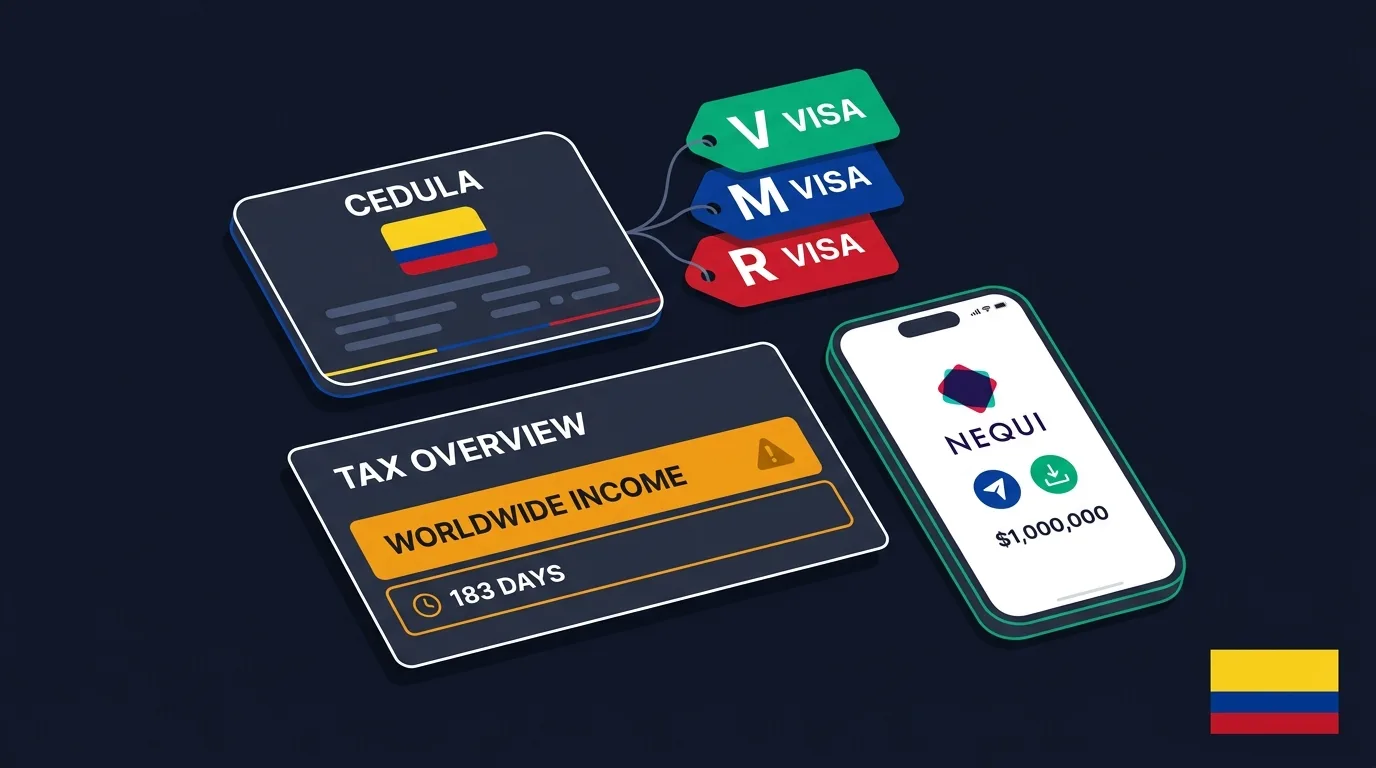
Colombia has gone from insider tip to a fixture of the nomad scene in a few years, Medellín above all: affordable, good climate, friendly, and with its own digital nomad visa since 2022. This guide covers the current state for someone earning online or from abroad who wants to stay longer without a local job, including the part that catches people out, the tax.
Residency: the V / M / R system
Colombia has three visa classes: V (Visitante), M (Migrante), and R (Residente). The key rule up front: only time on an M or R visa counts toward permanent residency. Time on a V visa, including the nomad visa, does not.
Digital nomad visa (V, since 2022)
For remote workers and online freelancers with foreign clients. You show income of at least three times the Colombian minimum wage per month (2026: roughly COP 5.25M, about USD 1,300-1,400). Valid up to two years. It does not lead to permanent residency, but it does get you a cédula.
M (Migrante, counts toward residency)
Several routes: regular passive income (rentista), a pension (around three times the minimum wage), real estate in your own name, a larger direct investment, or your own company. Investment funds must be registered with the central bank.
R (Residente)
After five continuous years on qualifying M visas (three if married to a Colombian), then indefinite with open work rights. An M visa lapses after more than 180 continuous days abroad, so permanent residency has to be lived.
Tax: residency triggers worldwide income
You become tax resident after 183 days within any rolling 365-day period (not the calendar year). Residents are taxed on worldwide income, progressive up to 39%. Non-residents pay only on Colombian-source income.
Here is the part that differs sharply by home country and that almost no one separates cleanly: the double-tax treaty.
- Switzerland has a treaty with Colombia (in force since 2012).
- Germany does not.
- Austria does not.
So Germans and Austrians lack the treaty mechanism that cleanly splits taxing rights. Double taxation is then only softened by a unilateral, capped credit, not avoided by treaty. Only the Swiss have treaty protection here. That makes the clean sequence especially important: end your home-country tax residency properly first, then arrive in Colombia.
Banking and payments
Almost everything hinges on the cédula de extranjería, the foreigner ID. You only get it with an M or R visa (or the nomad visa), not as a tourist. Without a cédula there is no real local account and no Nequi, the everyday payment app. Account opening is in person; you cannot do it from abroad. For transfers from Europe, Wise pays out in COP to a local account.
Cost of living
A comfortable budget runs about USD 1,500-2,000 a month in either big city. Medellín and Bogotá sit in the same band; sought-after areas like El Poblado and Laureles in Medellín, or northern Bogotá, are at the upper end. Figures move with the peso, so treat them as orders of magnitude.
Citizenship
Naturalization comes five years after the R visa is issued (shorter for Latin American and Iberian nationals; the full term for Germans, Austrians, and Swiss, unless via marriage or a Colombian child, then two years). Colombia allows dual nationality; whether your home country does depends on your country.
This is general information, not tax or legal advice. Thresholds and rules change and depend on your facts; have residency and tax reviewed locally before deciding. Running your business through a US LLC? Learn about our formation services →

Written by Chris Natterer
Founder of Globalization Guide, helping international entrepreneurs form and manage US companies since 2019.