


Brazil residency: worldwide-income tax, visas, and the CPF
Brazil for people with foreign income: when you become tax resident on worldwide income, the Germany treaty gap, the digital nomad and investor visas, the CPF, banking, and cost of living. Updated 2026.
By Chris Natterer · Last updated June 22, 2026
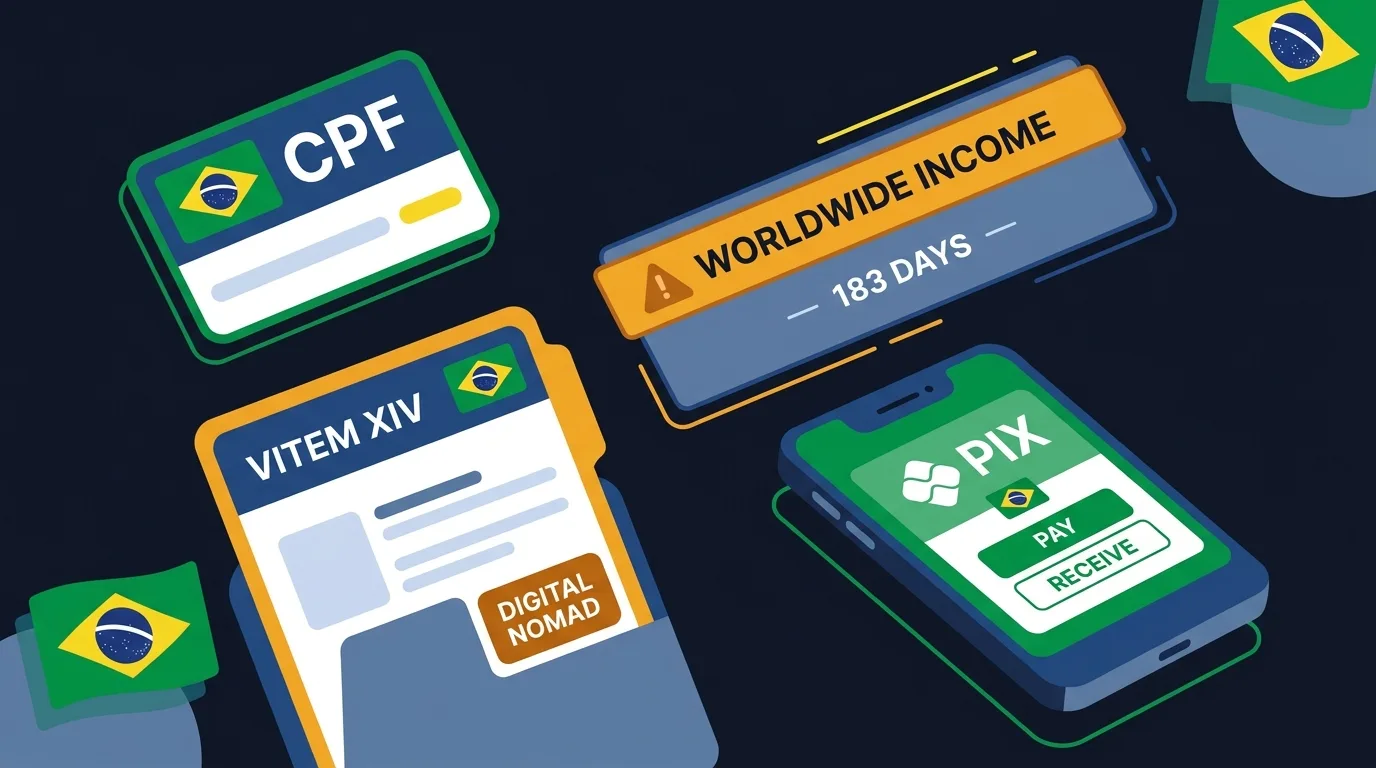
Brazil is a place people move to for life, not for a tax trick, and it is important to be clear about that from the start. This guide covers residency, the worldwide-income tax that is the backbone of any honest Brazil plan, the visas, and the practical setup (CPF and banking) for someone with foreign or online income.
Tax: residency means worldwide income
Brazil taxes residents on worldwide income, at progressive rates up to 27.5%. You become tax resident in one of two ways: holding a permanent visa makes you resident from the date of entry; temporary status without a Brazilian employment contract makes you resident after 183 days within any 12-month period. There is no remittance trick here, residence means your global income is in scope.
The treaty picture is asymmetric across the German-speaking countries, and this is the single most important point for the reader:
- Germany has no treaty with Brazil. Germany terminated the old one effective 1 January 2006, and it was never replaced. Germans get only a weaker reciprocity-based foreign tax credit, with no allocation rules.
- Austria has a treaty in force.
- Switzerland has a treaty in force (signed 2018).
So a German moving to Brazil carries a real double-taxation risk that an Austrian or Swiss person does not. Either way, end your home-country tax residency cleanly before becoming a Brazilian resident.
Main long-stay visas
Digital nomad (VITEM XIV)
For remote workers with foreign income: about USD 1,500/month income or USD 18,000 in savings. One year, renewable once.
Investor (VIPER)
Permanent from day one, against an investment of roughly BRL 700,000 in real estate or BRL 500,000 in a business.
Retirement / pensioner
A separate route from the nomad visa, for those with a pension of around USD 2,000/month.
CPF: get it first
The CPF (the Brazilian tax ID) is required for almost everything: banking, Pix, rentals, even a SIM card. It is free and quick, applied for online via Receita Federal, at a consulate, or in person, and issued within a few days. Nothing else works smoothly until you have it.
Banking and payments
Nubank and most fintechs require a CPF plus proof of address. Wise can hold and receive BRL, but a CPF is still needed for Pix, Brazil's instant-payment system. The practical order is simple: CPF first, then a local account or fintech, then Pix.
Cost of living
| City | Comfortable monthly budget |
|---|---|
| São Paulo | USD 1,500-3,500 |
| Belo Horizonte | USD 1,000-2,000 |
This is general information, not tax or legal advice. Rules and thresholds change and depend on your facts; have residency and tax reviewed locally before deciding. Running your business through a US LLC? Learn about our formation services →

Written by Chris Natterer
Founder of Globalization Guide, helping international entrepreneurs form and manage US companies since 2019.