


Travel hacking: is the effort really worth it?
What US credit card points are actually worth, how much effort and risk sits behind them, and who travel hacking pays off for. For 2026.
By Chris Natterer · Published June 11, 2026
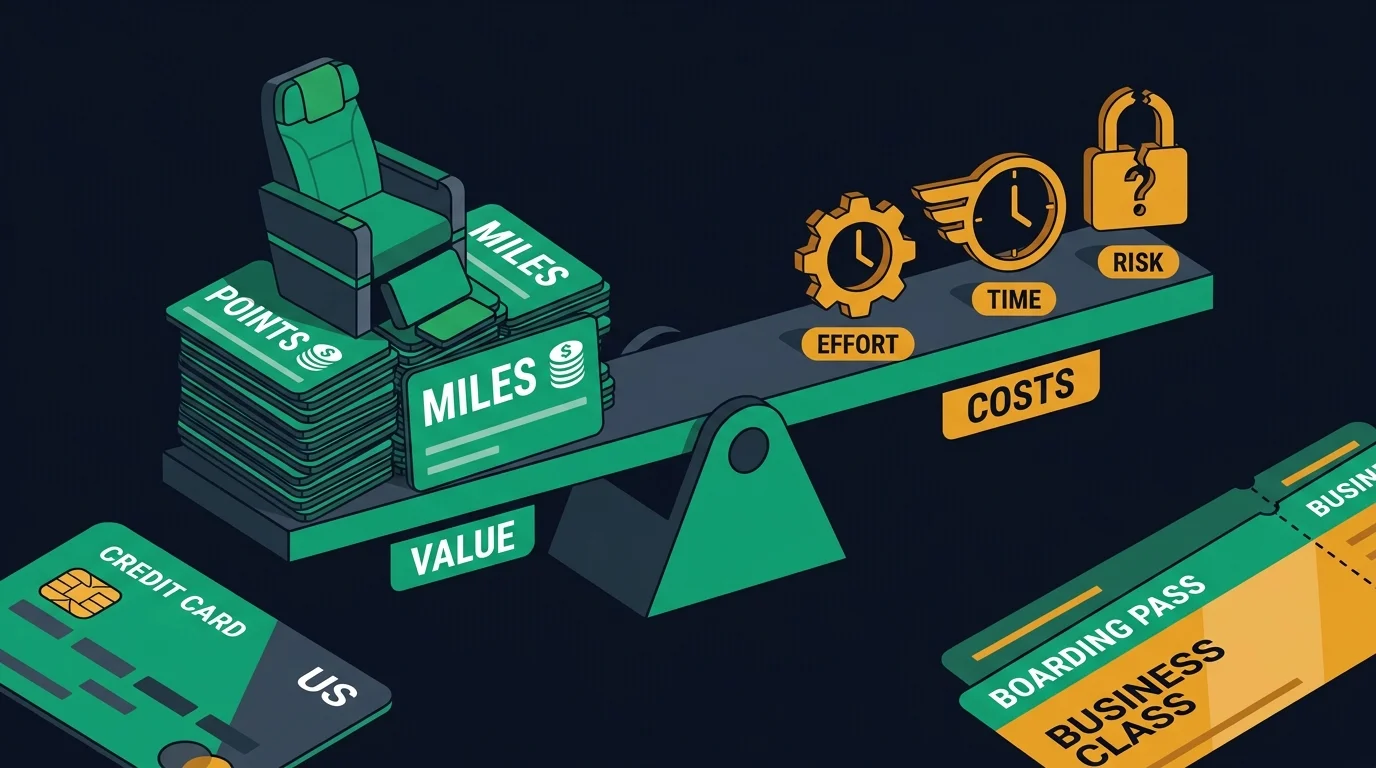
Travel hacking often gets pitched as something that runs itself: a few cards, a few bonuses, and you’re flying business class around half the world. The gains are real, but they have a flip side. This article runs both sides of the math: what the points are worth, what it costs in effort and risk, and who the whole thing pays off for.
Why there’s so much to grab with US cards in the first place
The reason is no magic, it’s a fee in the background. When you pay by card, the merchant pays an interchange fee. In the EU it’s capped by regulation at 0.30 percent, in the US it sits around 1.8 to 3.3 percent depending on the card.
Banks fund their rewards out of that gap. So US cards have six to seven times the budget for points and bonuses. That explains why Europe has no sign-up bonuses in the range of 60,000 to 125,000 points and the US does.
What the points are actually worth
An example makes it concrete. A sign-up bonus of 75,000 points is roughly enough, redeemed well, for a business-class flight from the US to Western Europe. The cash price of a ticket like that quickly runs to 3,000 to 6,000 dollars.
For orientation:
- Business class US to Western Europe: from around 60,000 points per leg.
- Economy on shorter routes: from around 12,000 points.
- On top of that, lounge access, hotel and travel credits, and status with airlines and hotels.
The biggest value almost always sits in a card’s sign-up bonus, not in the ongoing collection of points on purchases. Use bonuses smartly and a single card pulls out the equivalent of an expensive long-haul flight.
What it costs: effort
Now the other side. Travel hacking is not passive income, it’s a hobby with bookkeeping.
- The build first. Without a US score and without an ITIN you can’t reach the good cards at all. That’s the six to twelve months from building a score.
- Applications and deadlines. Bonuses are tied to minimum spend within a time window. You have to plan that and keep an eye on it.
- Redeeming is its own art. Points are only worth as much as you get out of them when you redeem. Finding good award flights costs time and patience.
- Staying on top of it. Multiple cards, multiple annual fees, multiple deadlines. Without a system you lose track fast.
What it costs: risk
And there are real pitfalls that tend to go missing from the success stories:
- Chase 5/24. Five or more new cards in 24 months, and Chase rejects you.
- Hard credit inquiries dent your score short-term. Every application costs points.
- Account closures. Banks, American Express in particular, can close accounts with little warning if behavior looks suspicious.
- Manufactured spending. Artificially generating spending to hit bonuses is risky and gets you shut down fast. Stay away from it.
Who it’s worth it for
It’s worth it if you already have or are building a US structure, travel internationally on a regular basis, and are willing to put some time into the build and upkeep. Then the payoff in flights, lounges, and status is real and repeats year after year. A single well-redeemed card can pay for a long trip.
It’s not worth it if you rarely fly, have no US structure and don’t want to build one, or if you’re hoping for a quick hit. Then the effort outweighs the return, and the annual fees annoy you more than the perks help.
The key points
- The value is real: a bonus can replace a business-class flight. The biggest lever is the sign-up bonus.
- The effort is real too: months of build, deadlines, redeeming, staying on top of it.
- The risks (5/24, shutdowns, manufactured spending) belong to the full truth.
- Worth it mainly for frequent travelers with a US structure. For occasional flyers, less so.
How the whole path from the first card to collecting points looks is in the overview, US credit cards for non-residents.
This article is a general orientation and not financial advice. Terms and bonus offers change constantly.

Written by Chris Natterer
Founder of Globalization Guide, helping international entrepreneurs form and manage US companies since 2019.