


US LLC for Non-Residents: How to Form and Run One in 2026
How a non-resident forms a US LLC in 2026: best state, real costs, EIN without SSN, remote banking, US tax and the yearly Form 5472. Step by step.
I form US LLCs for founders who live outside the US and keep them compliant afterwards. In the 2026 tax season alone I filed over 100 Form 5472 returns for clients. This guide is everything I tell a new client in the first call: whether an LLC fits you, how to set one up step by step without ever visiting the US, what it really costs, how it is taxed, and which filings keep it out of trouble.
The short version:
- Who can do it: anyone. You don’t need US citizenship, residency, a visa, an SSN or an ITIN.
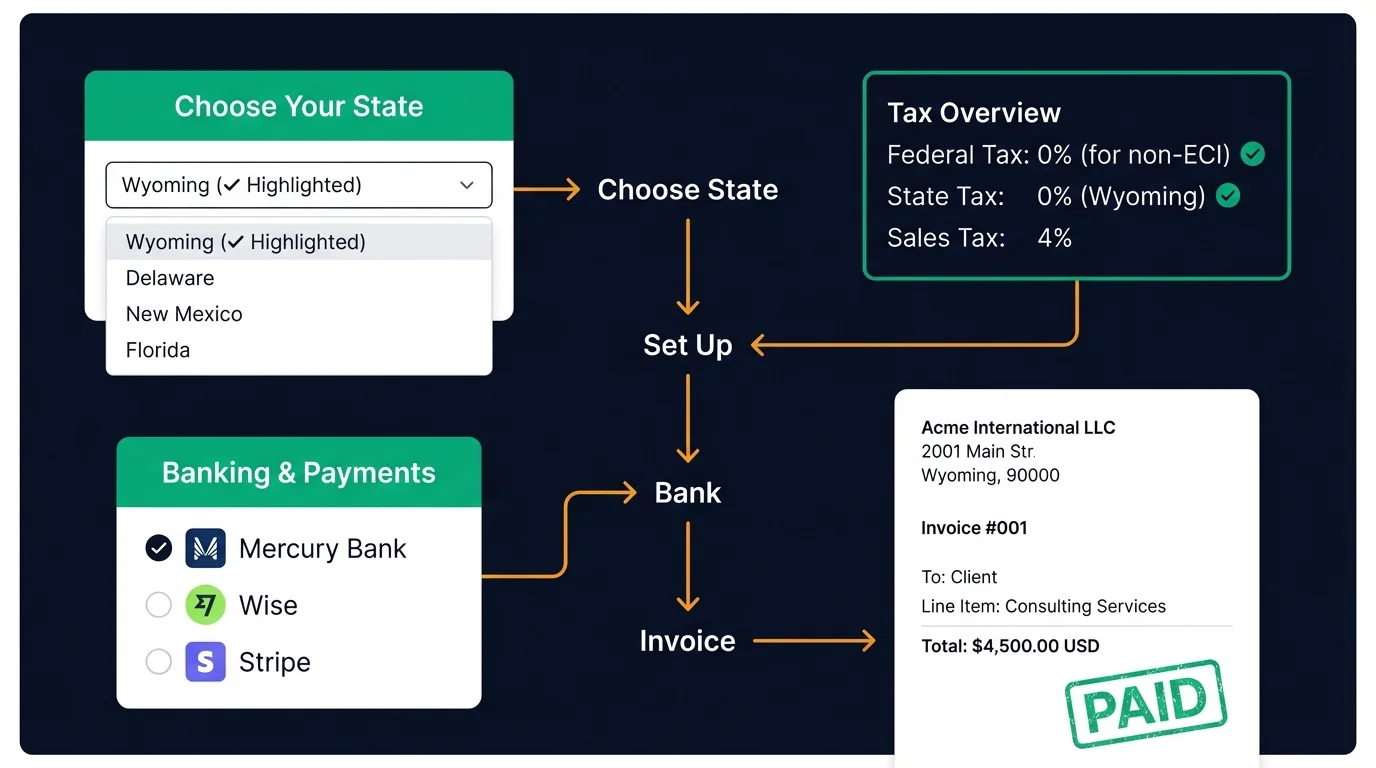
- Best state for most non-residents: Wyoming. New Mexico if cost is everything, Delaware only if you plan to raise venture capital.
- Timeline: about 1 week for the LLC, 2 to 6 weeks for the EIN depending on the route, then 1 to 2 weeks for a bank account.
- Cost: $270 to $600 in the first year if you do it yourself, or $1,250 all-in with me, state fee, EIN and first-year registered agent included.
- Every year after: Form 5472 with a pro forma 1120 to the IRS (penalty for missing it: $25,000), plus your state’s annual report.
Is a US LLC the right structure for you?
A US LLC works well for non-residents because of four things:
- Reputation. Clients, platforms and payment processors trust a US company. Invoices from a Wyoming LLC raise fewer questions than invoices from an offshore company.
- Banking and payments. With an LLC and an EIN you can open US business accounts remotely and get Stripe, which is still out of reach in many countries.
- Low cost. Formation takes days, not months, and no lawyer is needed. A comparable company in Canada or most of Europe costs several times as much to set up and maintain.
- Tax transparency. A single-member LLC owned by a non-resident is usually not taxed in the US at all (details below). That is the part people get most excited about and most often get wrong.
It works for consulting and freelancing, agencies, SaaS, digital products, e-commerce and dropshipping. Amazon FBA works too, but inventory in US warehouses changes the tax picture, so get that checked first.
When it is the wrong choice: if you are a US citizen, green card holder or live in the US, the LLC is taxed like any other US business. And if your home country taxes you on worldwide income, an LLC does not make that tax disappear. It moves where the money is booked, not where you owe tax. Read how CFC rules work in your country before you assume a tax benefit.
How a non-resident’s LLC is taxed in the US
A single-member LLC is a disregarded entity. The IRS ignores it for income tax and looks straight through to you, the owner. If you are a non-resident alien, you owe US federal income tax only on income that is effectively connected with a US trade or business (ECI).
In practice, your LLC stays outside US income tax if all three are true:
- It is 100% owned by non-US persons. No US citizen, green card holder or person who meets the substantial presence test among the members.
- There is no US trade or business. You have no office, no employees and no dependent agent working for you inside the US. Selling to US customers from abroad does not count as a US trade or business on its own.
- The income is not effectively connected. Services you perform from outside the US are foreign-source income, even when the client is American.
If a tax treaty applies between the US and your country, the bar is even higher: you would also need a permanent establishment in the US before tax applies.
Two quick examples:
- A consultant living in Portugal who serves US clients remotely through a Wyoming LLC, with no US staff or office: no US income tax. Portugal still taxes the profit.
- An Amazon FBA seller whose stock sits in US fulfillment centers: the warehouses can create state sales tax nexus and need a closer look for federal purposes.
The full test with the edge cases is in my guide on when a US LLC owes US tax (ETBUS and ECI). For countries that only tax local income, see territorial tax systems.
How to open a US LLC as a non-resident: 7 steps
- Choose the state
- Get a registered agent and a business address
- Form the LLC
- Apply for an EIN
- Open a business bank account
- Set up payment processing
- Optional: get an ITIN
Step 1: Choose your state
You can form your LLC in any state, no matter where your customers are. For non-residents, four states matter:
| State | Formation fee | Yearly state cost | Owner privacy | Best for |
|---|---|---|---|---|
| Wyoming | $100 | $60 annual report (minimum) | Yes | Most non-residents |
| New Mexico | $50 | $0, no annual report | Yes | Lowest running cost |
| Delaware | $110 | $400 annual tax (since 2026) | Yes | Raising venture capital |
| Florida | $125 | $138.75 annual report | No, members listed | Some EU banks want a “real” state |
My default recommendation is Wyoming: low fees, no state income tax, good privacy and a mature registered-agent industry. The full comparison is in best state for a non-resident LLC.
Step 2: Get a registered agent and a business address
Every LLC needs a registered agent with a physical address in its state. The agent receives official and legal mail for the company. A formation service usually includes the first year.
Separately, you want a business mailing address for the IRS, banks and normal mail. The registered agent address is often not accepted by banks and card issuers, and some virtual mailboxes (CMRA addresses) get flagged. I explain the difference in US address for non-residents.
Step 3: Form the LLC
Check that your name is available in the state database first:
- Wyoming: wyobiz.wy.gov
- New Mexico: portal.sos.state.nm.us
- Delaware: icis.corp.delaware.gov
Have three name options ready, at least one of them clearly distinctive. Filing the Articles of Organization takes 15 minutes online and the state approves them within 1 to 5 business days.
You end up with:
- Articles of Organization, the founding document of the LLC
- Statement of Organizer, transferring control from the organizer to you
- Operating Agreement, not filed with the state but asked for by almost every bank
Step 4: Apply for an EIN
The EIN (Employer Identification Number) is the company’s tax number, issued by the IRS. You need it to open a bank account, to use Stripe and to file Form 5472.
Non-residents without an SSN or ITIN can’t use the IRS online application. You file Form SS-4 by fax, by mail or through the IRS international phone line instead. By fax it usually takes 4 to 6 weeks, by mail longer. The exact process, including what to write on line 7b, is in how to get an EIN without an SSN. With my EIN service it typically takes 2 to 5 business days.
Step 5: Open a business bank account
These fintechs open accounts for non-resident-owned LLCs fully remotely:
| Bank | Currencies | Good for |
|---|---|---|
| Mercury | USD | Full-featured US business banking |
| Relay | USD | Simple, no-fee banking with many sub-accounts |
| Wise Business | 40+ currencies | Paying and getting paid internationally |
| Revolut Business | 25+ currencies | European clients and cards |
Which ones accept you depends on your country of residence and your business model, and their lists change often. I usually set clients up with one US bank (Mercury or Relay) plus Wise for multi-currency. More options and what to do after a rejection: opening a US bank account as a non-resident.
Banks typically ask for the Articles of Organization, the EIN confirmation letter (CP 575 or 147C), your passport, proof of your home address and a clear description of the business. A simple website and a domain email address help a lot.
Traditional banks like Chase or Bank of America generally require a visit to a US branch.
Step 6: Set up payment processing
Stripe accepts US LLCs owned by non-residents. You need the LLC, the EIN, a US bank account, a working website with your terms and prices, and ideally a domain email.
PayPal asks for an SSN or ITIN for a US business account. Without one, many founders keep using their personal PayPal at home until they have an ITIN.
Step 7 (optional): Get an ITIN
An ITIN is a personal US tax number for people who can’t get an SSN. You don’t need it to form or run the LLC. It helps with PayPal, some card issuers and building US credit. The usual route is applying with Form W-7 together with a tax filing. See my ITIN application service.
What a US LLC really costs
Doing it yourself, first year (Wyoming):
| Item | Cost |
|---|---|
| State formation fee | $100 |
| Registered agent | $50 to $150 per year |
| Business mailing address | $120 to $200 per year |
| EIN | Free (by fax), or $100 to $200 through a service |
| Bank account | Usually free |
| Total | about $270 to $600 |
On top of that, budget for the yearly Form 5472 if you file it yourself or through a CPA.
Done for you: I form the LLC in Wyoming, New Mexico, Florida or Delaware for $1,250, with the state fee, fast-track EIN, operating agreement, first-year registered agent and bank account support included. From year two, the all-in yearly package (registered agent, annual report with state fee, Form 5472 and pro forma 1120) is $900 to $1,350 depending on the state. Details on the LLC formation page.
What you have to file every year
A foreign-owned single-member LLC has two recurring obligations:
- Form 5472 with a pro forma Form 1120 to the IRS, due April 15 (extension to October 15 possible). It is an information return, not a tax payment, and it is required even in a year with almost no activity: paying the formation fee from your own pocket already counts as a reportable transaction. The penalty for a late or missing form is $25,000. Full walkthrough: Form 5472 for foreign-owned LLCs.
- The state annual report and fee: Wyoming on the first day of your formation month, Delaware annual tax ($400) by June 1, Florida by May 1, New Mexico none.
BOI reports under the Corporate Transparency Act no longer apply to LLCs formed in the US since FinCEN’s March 2025 rule. What changed.
Multi-member LLCs file Form 1065 instead of Form 5472. All requirements side by side: annual filing requirements for non-resident LLCs.
Mistakes I see every tax season
- Skipping Form 5472 because “the LLC did nothing.” The $25,000 penalty hits dormant LLCs too. If you are already late, read how the penalty and abatement work before you do anything else.
- Using the registered agent address for the bank. It gets rejected or causes the account to be closed later.
- Assuming “no US tax” means “no tax.” Your home country decides how the profit is taxed.
- Mixing personal and business money without records. Every transfer between you and the LLC belongs on Form 5472, so simple bookkeeping saves you hours in April.
Want me to set up your LLC?
Wyoming, New Mexico, Florida or Delaware. State fee, fast-track EIN, operating agreement and first-year registered agent included.
Start your LLC formation$1,250 one-time. Fully remote, no SSN or US visit needed.
Not sure yet whether an LLC fits your situation? Book a consultation and we go through it together.
Frequently asked questions
Can a non-resident own a US LLC?
Yes. There is no citizenship or residency requirement in any state. You can be the sole member and manager while living anywhere in the world, with a few exceptions for sanctioned countries.
Do I need to travel to the US?
No. Formation, EIN and the fintech bank accounts above all work remotely. Only traditional banks like Chase require a branch visit.
How long does it take until I can invoice clients?
With a fast-track EIN, about 2 to 3 weeks from start to a working bank account. With a standard fax EIN, plan for 6 to 8 weeks.
Does my US web host create a US tax presence?
No. A server or web host in the US is not a permanent establishment or a dependent agent.
Do I need bookkeeping for my LLC?
The IRS doesn’t require formal books from a single-member LLC owned by a non-resident, but you need the numbers for Form 5472 and for your home country’s tax return. A simple spreadsheet or a tool like Wave is enough for most.

Written by Chris Natterer
Founder of Globalization Guide, helping international entrepreneurs form and manage US companies since 2019.