


The Form 5472 late filing penalty: $25,000, and how to get it abated
The Form 5472 penalty is $25,000 per form under IRC §6038A. Here is how the penalty works, why even a dormant LLC gets hit, and the real routes to abatement: reasonable cause, First-Time Abate, and the delinquent-return procedures.
By Chris Natterer · Last updated June 20, 2026
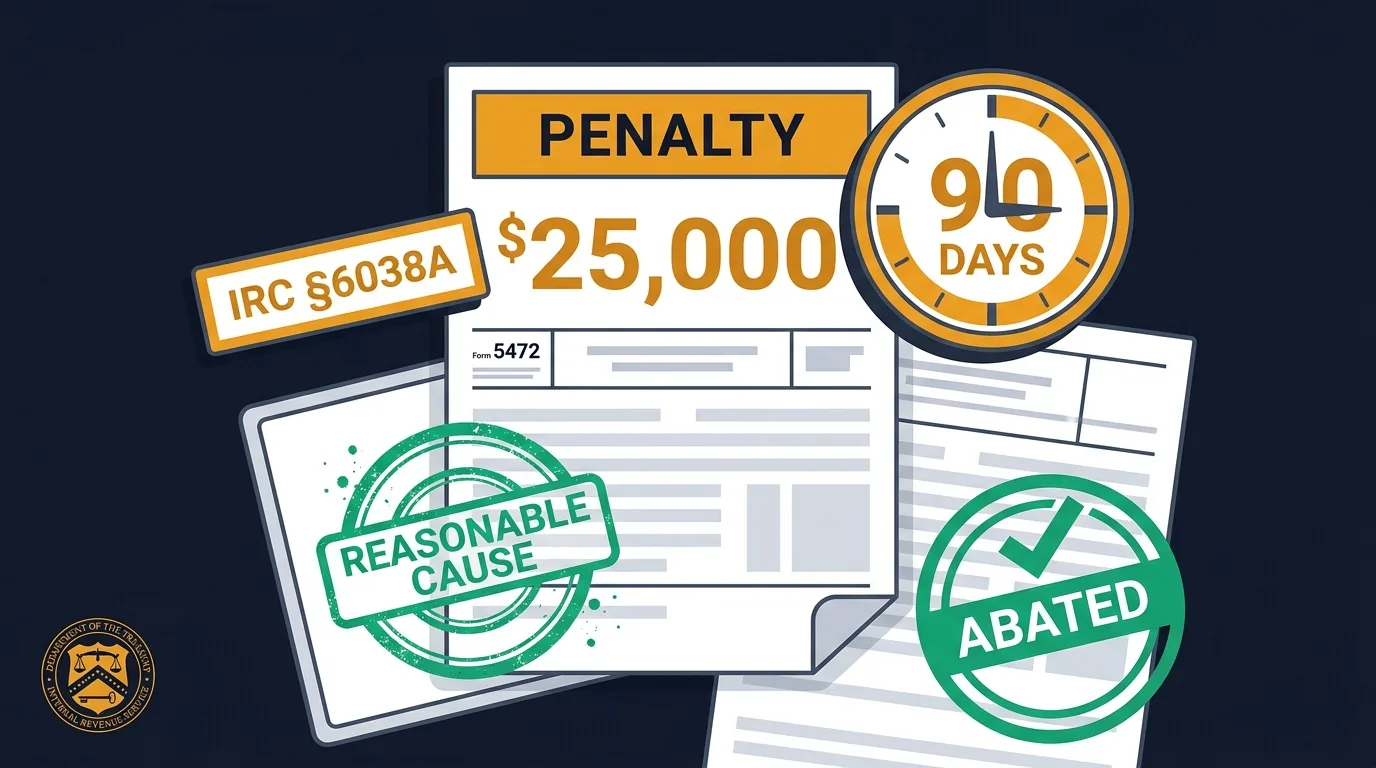
If you own a US LLC from outside the US and you missed Form 5472, you are looking at a $25,000 penalty per form. It is one of the harshest penalties a small, often dormant company can run into, and the IRS now assesses it automatically. This guide explains how the penalty works, why it hits even an LLC that never made a dollar, and the realistic ways to get it removed.
The short version
- The penalty is $25,000 per Form 5472 not filed on time or filed incomplete (IRC §6038A).
- If you ignore the IRS notice, another $25,000 is added every 30 days, starting 90 days after the notice, with no upper limit.
- It applies even with zero income and zero tax. It is a penalty for not filing the information return, not for owing money.
- The main way out is reasonable cause. A narrow First-Time Abate path can also work. Both are case by case.
- Not filing also keeps the statute of limitations open on your whole return under §6501(c)(8), so the problem does not just age away.
What the penalty actually is
Form 5472 is the information return a foreign-owned US LLC files every year to report transactions with its owner. The filing duty sits in IRC §6038A, and so does the penalty. A failure to file a timely, complete, and accurate Form 5472 triggers a $25,000 penalty per return.
This amount was $10,000 until the 2017 Tax Cuts and Jobs Act raised it to $25,000 for tax years starting after 2017. If the IRS sends you a notice of the failure and you still don't file, the penalty grows by another $25,000 for each 30-day period after a 90-day grace window. Unlike the Form 5471 penalty, there is no maximum.
The penalty is now largely systematic: when a foreign-owned LLC files its 1120 with Form 5472 late, IRS systems often assess the $25,000 automatically, before any human looks at your reasons.
Why a dormant LLC still gets hit
The most common and most painful case I see is the founder who opened an LLC, did little or nothing with it, and assumed there was nothing to file. That assumption is wrong.
A foreign-owned single-member LLC is a disregarded entity that must file Form 5472 together with a pro forma Form 1120, purely as an information return. Almost any money movement between you and the LLC counts as a reportable transaction, including the money you paid to form the company. So even an LLC with no customers and no profit usually has a Form 5472 obligation. The full mechanics are in my guide to Form 5472.
The hidden cost: your return never closes
There is a second consequence that is easy to miss. Under §6501(c)(8), the statute of limitations on assessment does not start to run until the required information is filed. In plain terms: as long as the Form 5472 is missing, the IRS can keep your related return open and examinable. The penalty is the visible problem; the open statute is the quiet one.
How to avoid the penalty in the first place
Avoiding it is far easier than fighting it.
- Confirm the obligation before year-end. If you have an LLC and any reportable transactions, assume you must file.
- File by the deadline. The pro forma 1120 with Form 5472 is due April 15, or October 15 with a timely Form 7004 extension.
- File even if there was no activity. A nil-activity LLC that paid only its own formation costs still files.
If you already missed it: the real abatement routes
If the form is late or a penalty already landed, you have a few genuine options. None is automatic, and the order matters.
1. Reasonable cause (the main route)
The §6038A penalty does not apply if the failure was due to reasonable cause and not willful neglect. Reasonable cause means you exercised ordinary business care and prudence in determining your obligations but still could not comply. It is decided case by case on all the facts (Reg. §1.6038A-4).
For a non-resident who genuinely did not know a dormant US LLC carried a filing duty, who acted promptly on learning of it, and who has otherwise been compliant, that story can support reasonable cause. You assert it in a written statement, either attached to the late return or in response to the penalty notice. Be specific and factual; "I didn't know" alone is weak, the surrounding facts are what carry it.
2. First-Time Abate (a narrow but real path)
The IRS First-Time Abate (FTA) policy normally does not apply to event-based forms like 5472. There is an exception worth knowing: the Internal Revenue Manual allows FTA for a systematically assessed 5472 penalty when the failure-to-file penalty on the related 1120 is abated under FTA, or would have been eligible but was never assessed because there was $0 tax due or the return was fully paid, and you had no similar penalties and no late related returns in the prior three years.
That fits a lot of dormant foreign-owned LLCs, where the pro forma 1120 shows no tax. It is narrow and the criteria are strict, but for a clean first-time case it can be the cleanest fix.
3. Delinquent International Information Return Submission Procedures
If you have not been contacted by the IRS and are not under examination, you can file the delinquent Form 5472 through amended-return procedures (for example attached to a Form 1120X) with a reasonable-cause statement on each late form. One honest caveat: the IRS says penalties may still be assessed by its systems before the reasonable-cause statement is read, so you may have to respond again to a notice. It is still better than waiting to be found.
How to respond to a penalty notice
If a CP215 or similar penalty notice arrives, do not ignore it; the 30-day clock and the no-maximum growth make silence expensive. Respond in writing within the stated window, attach your reasonable-cause statement and any supporting documents, and keep proof of filing. If the first response is denied, you can request appeals. This is the point where having someone who has done it before is worth it.
Where I can help
I prepare and file Form 5472 for non-resident LLC owners, and I help people who are already facing a penalty put together a reasonable-cause response. If you have a late form or a $25,000 notice, the worst move is to wait. Get in touch and we will look at your specific case.
This is general information, not tax or legal advice. Penalty relief depends entirely on your specific facts, and outcomes are never guaranteed. Have your case reviewed before responding to the IRS. Sources: IRS Instructions for Form 5472, IRC §6038A.

Written by Chris Natterer
Founder of Globalization Guide, helping international entrepreneurs form and manage US companies since 2019.