


When does a US LLC actually owe US tax? ETBUS and ECI explained
The 'US LLC is always tax-free' idea is a myth. Here is when a non-resident-owned LLC really owes US tax: the US-trade-or-business test, effectively connected income, and the treaty permanent-establishment overlay.
By Chris Natterer · Last updated June 20, 2026
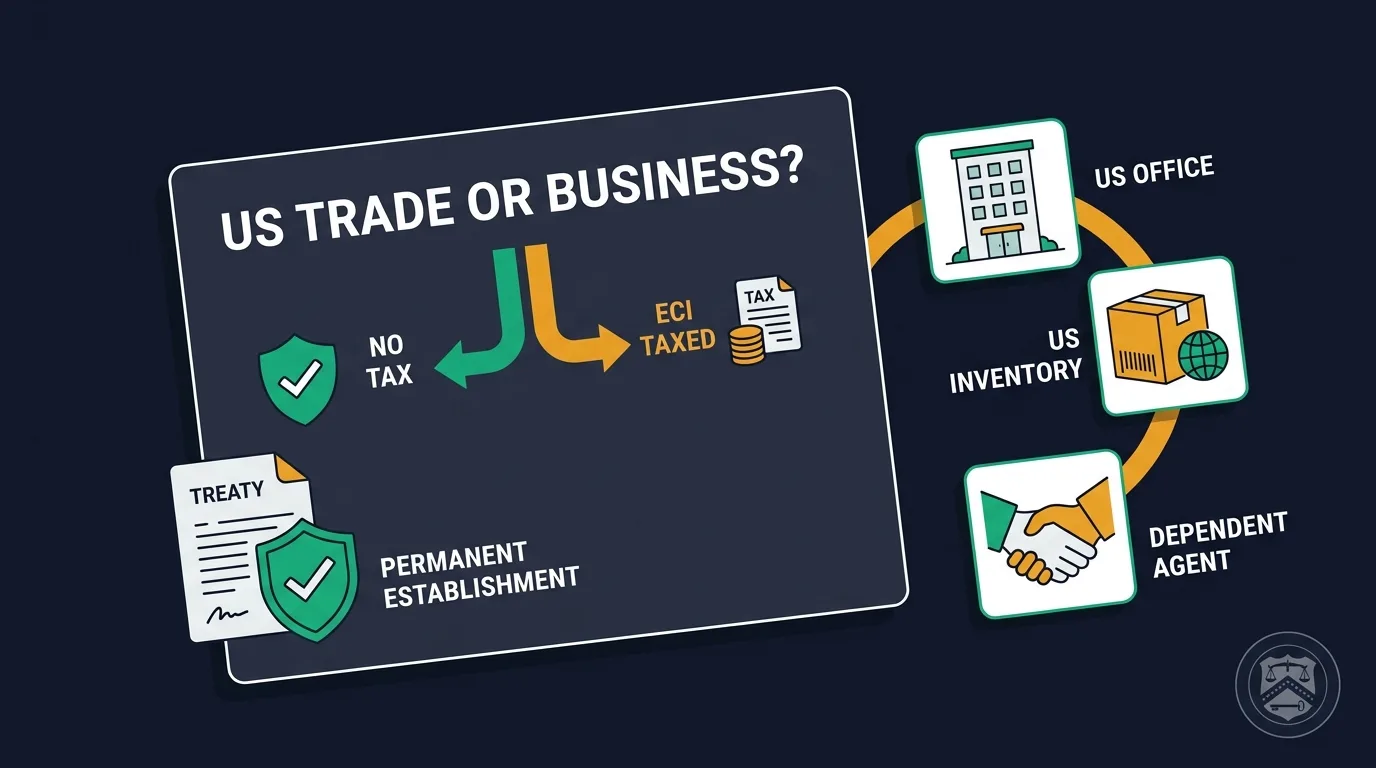
The idea that a US LLC is automatically tax-free for a non-resident is the single most repeated myth in this field, and it is wrong as a blanket statement. The truth is more useful: a foreign-owned LLC owes no US income tax on its profits only when it is not doing business in the US, and for treaty-country residents, only when it has no US permanent establishment. This guide explains exactly where that line sits.
The short version
- A US LLC is not tax-free by definition. It is tax-free on its business profits only if there is no US trade or business.
- The two domestic concepts are ETBUS (engaged in a US trade or business) and ECI (effectively connected income). ECI is taxed; non-ECI usually is not.
- For residents of a treaty country (most of Europe), business profits are US-taxable only if you have a US permanent establishment.
- Even when no US tax is due, you still have to file, and your home country can tax the profits.
The default many non-residents are in
A lot of non-resident owners run a genuinely location-independent business: they work from abroad, have no US office, no US staff, and no US inventory. In that case the LLC typically has no US trade or business, so its profits are not effectively connected income, and there is no US federal income tax on them. This is where the "tax-free" idea comes from. It is real, but it is a conclusion you reach after the test, not a property of the LLC itself. You still file your Form 5472 or partnership return.
ETBUS: engaged in a US trade or business
US tax on business income starts with whether you are engaged in a trade or business in the United States (§864). There is no single bright-line definition, but it generally means considerable, continuous, and regular business activity carried on in the US. Things that point toward a US trade or business include:
- A dependent agent in the US acting on your behalf (negotiating or concluding contracts).
- A US office or fixed place of business.
- US employees.
- US inventory and warehousing, including goods stored in US fulfillment centers.
Working at your laptop from outside the US for clients, even US clients, with none of the above, generally does not create a US trade or business.
ECI: the income that actually gets taxed
If you are engaged in a US trade or business, the income connected to it is effectively connected income and is taxed at the normal graduated US rates, the same brackets US persons face. A non-resident individual reports it on Form 1040-NR; a foreign corporation on Form 1120-F. Income with no connection to a US trade or business is generally not taxed this way (a separate flat-rate regime applies to certain US-source passive income like dividends, which is a different topic).
The treaty overlay: permanent establishment
Here is the part that matters most for European owners and that the "tax-free" crowd usually skips. If you are a resident of a country with a US tax treaty, the treaty generally lets the US tax your business profits only if you have a US permanent establishment (a fixed place of business, or a dependent agent with contract authority). A US permanent establishment is a higher bar than the domestic trade-or-business test.
So a treaty-country resident can be engaged in a US trade or business under domestic rules and still owe no US income tax because there is no permanent establishment under the treaty. You do not get this automatically: you claim treaty protection by filing the return with a treaty-position disclosure (Form 8833). No filing, no protection.
The Amazon FBA gray area, honestly
FBA sellers are the clearest example of why this is not simple. Storing inventory in US fulfillment centers can, under domestic rules, create a US trade or business and effectively connected income. Under many treaties, though, a warehouse alone may not be a permanent establishment, so a treaty-country seller may end up with no US income tax, while a seller from a non-treaty country may be fully exposed. Practitioners genuinely disagree on parts of this. If FBA is your model, treat it as a case for real advice, not a forum rule of thumb.
The honest bottom line
"LLC equals tax-free" is the wrong mental model. The right one is: a US LLC is a pass-through, and US tax depends on whether there is US-connected income and, for treaty residents, a US permanent establishment. On top of that, the profits are almost always taxable where you live. The US question and the home-country question are separate, and you have to get both right.
Where I can help
If you are unsure whether your LLC has US-connected income or a US permanent establishment, that is exactly the analysis worth doing before you file, not after a notice. Get in touch and we will work through your specific facts.
This is general information, not tax or legal advice. The US-trade-or-business and treaty analysis is fact-specific and contested at the edges. Sources: IRS: Effectively Connected Income, IRC §864.

Written by Chris Natterer
Founder of Globalization Guide, helping international entrepreneurs form and manage US companies since 2019.