


US Address for Non-Residents: Personal, Business & Banking
Not every US address works for banking. The CMRA problem, residential vs business addresses, the permanent-establishment trap, and how to pick one banks accept.
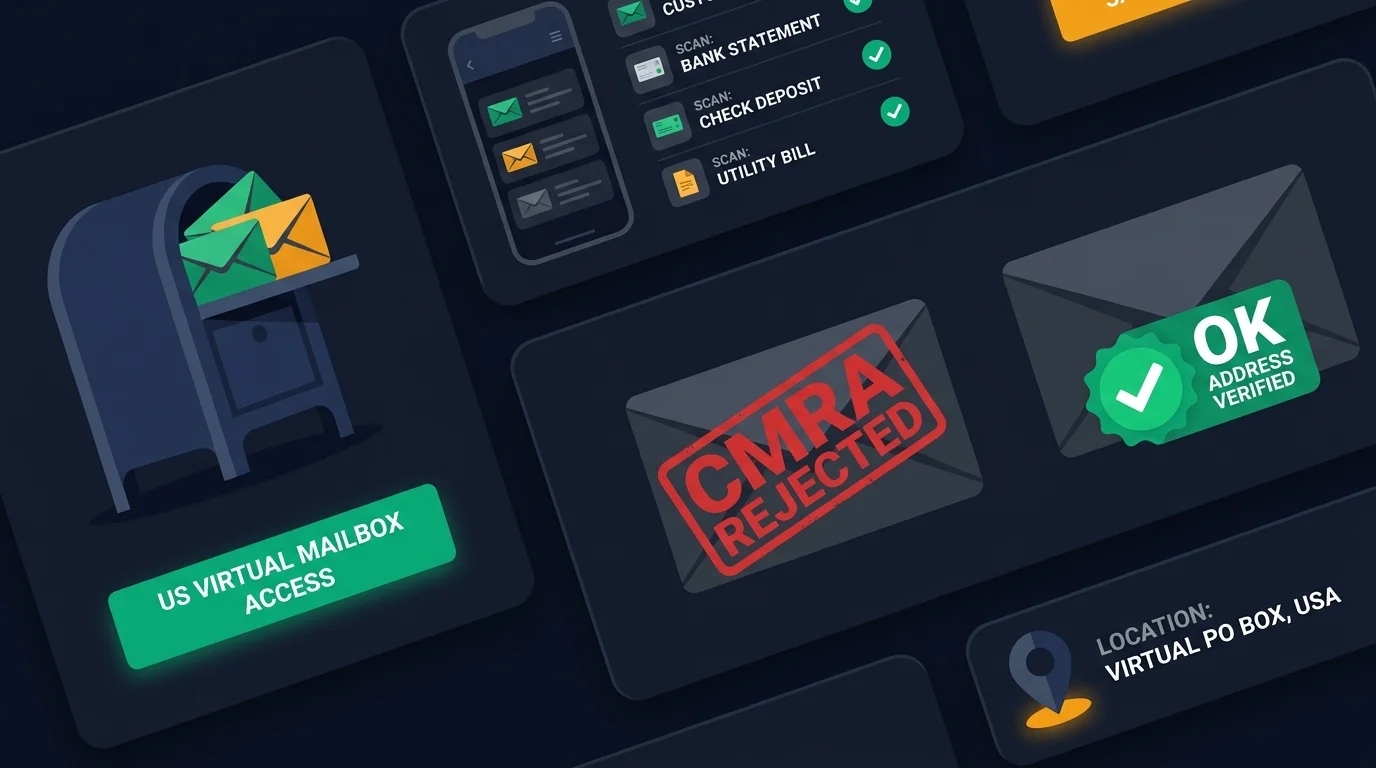
A US address is often the missing piece for a non-resident: for US cards, for bank mail, for personal accounts like Schwab, and for building US credit. The catch nobody tells you about is that not every US address works, and a "personal" address and a "business" address are two different things. This guide explains the difference, the CMRA problem that gets addresses rejected, the tax trap hiding behind a real office, and how to choose an address that actually holds up.
Two Different Addresses, Two Different Jobs
Most confusion here comes from treating "a US address" as one thing. It is two:
- A personal (residential) address is tied to you as an individual. Banks want it for personal accounts and credit cards, and it should be coded as an actual home or apartment.
- A business (commercial) address is tied to your company. Your LLC needs one for its registered agent and its mailing address, and it is coded as commercial.
Larger banks increasingly want both when a non-resident opens a business account: a real US address for the company and a real personal address for the owner. Mixing them up, or using one where the other is expected, is a common reason applications stall.
Why Banks Are Picky: the CIP Rule
US banks operate a Customer Identification Program under federal law (31 CFR 1020.220). For an individual, the rule requires a residential or business street address. That has one immediate consequence: a PO Box does not satisfy it. A post office box is the fastest way to get an application declined, so leave it out entirely.
The CMRA Problem
Here is the real stumbling block. When a commercial mail service receives mail on your behalf, that address is registered with the US Postal Service as a CMRA (Commercial Mail Receiving Agency), authorized through USPS Form 1583. The postal data flags it as a CMRA, and many banks read that flag and reject the address because it is not a real residence.
The postal system broadly separates a residential coding (the Residential Delivery Indicator) from the CMRA commercial-mail flag. An address coded as a CMRA fails with address-sensitive banks. That is exactly why two virtual mailboxes that look identical can behave completely differently: one is flagged, the other is not.
Check before you use it. Run any address through an address-validation tool (for example Smarty, which exposes the USPS CMRA and RDI flags) before you give it to a bank or card issuer. The rule of thumb: the less an address looks and codes like a mail drop, the more likely it is accepted.
Personal Address: the Options
- A friend or family member's home. A real, residentially coded address that is almost certainly not "burned." Best for the small amount of mail a personal account generates (cards, statements). The cost is social, not financial: you are asking someone to handle your mail for years.
- Your actual foreign address. A handful of banks, often through a referral, will open a personal account on your real home-country address. It is not common with mainstream US banks, which still prefer a US address.
- A residentially coded virtual mailbox. A virtual mailbox whose address is not flagged as a CMRA. These exist but take searching for, and you must verify the coding yourself.
- Renting a place. A genuine residential lease gives the most credible address and works well for bank applications, but it is expensive (think a few hundred dollars a month plus deposits) and you still need someone to handle the physical mail when a card expires.
Business Address: the Options
- Your registered agent's address. Your LLC needs a registered agent, but the agent's address is not a real business address. Everyone, banks included, recognizes it as a registered-agent address, and it does little to establish that the company operates somewhere. See what the agent actually does on the registered agent service page.
- A commercial virtual address. Better than a registered-agent address if it is competitively priced and not itself flagged as a mail drop, but many of the popular ones are heavily reused and show up as exactly that.
- A coworking space (WeWork, Regus and similar). Generally read as a "real place," a step up from a virtual address, and usually includes mail handling. It costs more and banks still recognize it as coworking.
- A real office. The strongest, most undeniable business address, but the most expensive, and it carries a tax warning below.
The Tax Trap: a Real Office Can Create US Tax
This is the part most "get a US address" advice skips. For a foreign-owned LLC, renting a genuine physical office in the US can create a fixed place of business, which is the classic trigger for being engaged in a trade or business in the US and, under a treaty, a permanent establishment. That can pull your otherwise non-taxable US income into US tax. In other words, the most "credible" business address can be the one that costs you the most. We break down exactly when this happens in When does a US LLC actually owe US tax? ETBUS and ECI.
What Actually Works at the Bank
Two broad patterns hold today. Traditional banks (Chase, Bank of America and the like) want a real US residential address and usually an in-person visit; they are the hardest path for a non-resident. The remote-friendly fintechs (Mercury, Relay, Wise) are more flexible: they will often work with a registered-agent or virtual business address for the company plus your real foreign personal address as proof of who you are.
Two caveats, stated honestly. First, this is a moving target: some of these providers have been tightening and asking for more concrete proof of where the owner actually works. Second, a workaround that relies on a single provider's current policy is fragile, if the account is closed you are back to square one. A real, well-coded address is the durable answer.
Pitfalls to Avoid
- PO Boxes. Not accepted for the CIP address. Skip them.
- "Burned" or CMRA-flagged addresses. Heavily reused mail-drop addresses get flagged and rejected, even if the service looks legitimate. Verify the coding first.
- Mail you cannot actually receive. Cards expire. If no one can receive and forward the replacement, you can lose access to the account. Plan the physical-mail path, not just the address.
- Sales tax of the address state. The address becomes a billing address, and the state can affect sales tax on purchases. A low-tax state can be worth choosing.
- The permanent-establishment trap. A real office can create US tax exposure, as above.
The Short Version
- Treat the personal and business address as two separate problems.
- Banks need a physical street address (CIP rule); a PO Box never works.
- Commercial mail services are coded as CMRA and are widely rejected. Check the coding (e.g. with Smarty) before you use an address.
- A registered-agent address is not a real business or banking address.
- The remote-friendly fintechs (Mercury, Relay, Wise) are the realistic path, but requirements are tightening.
- A real US office can create US tax exposure for a foreign-owned LLC. Weigh that before renting one.
For how the address fits the bigger setup, see the US LLC guide for non-residents and US business banking for your LLC.
Sources
- 31 CFR 1020.220 (Customer Identification Program), eCFR
- USPS: Commercial Mail Receiving Agency (CMRA) and USPS Form 1583
This article is general information, not legal or tax advice. Providers, prices, and which addresses banks accept change constantly. Verify the current state of play before you rely on any single option.

Written by Chris Natterer
Founder of Globalization Guide, helping international entrepreneurs form and manage US companies since 2019.