
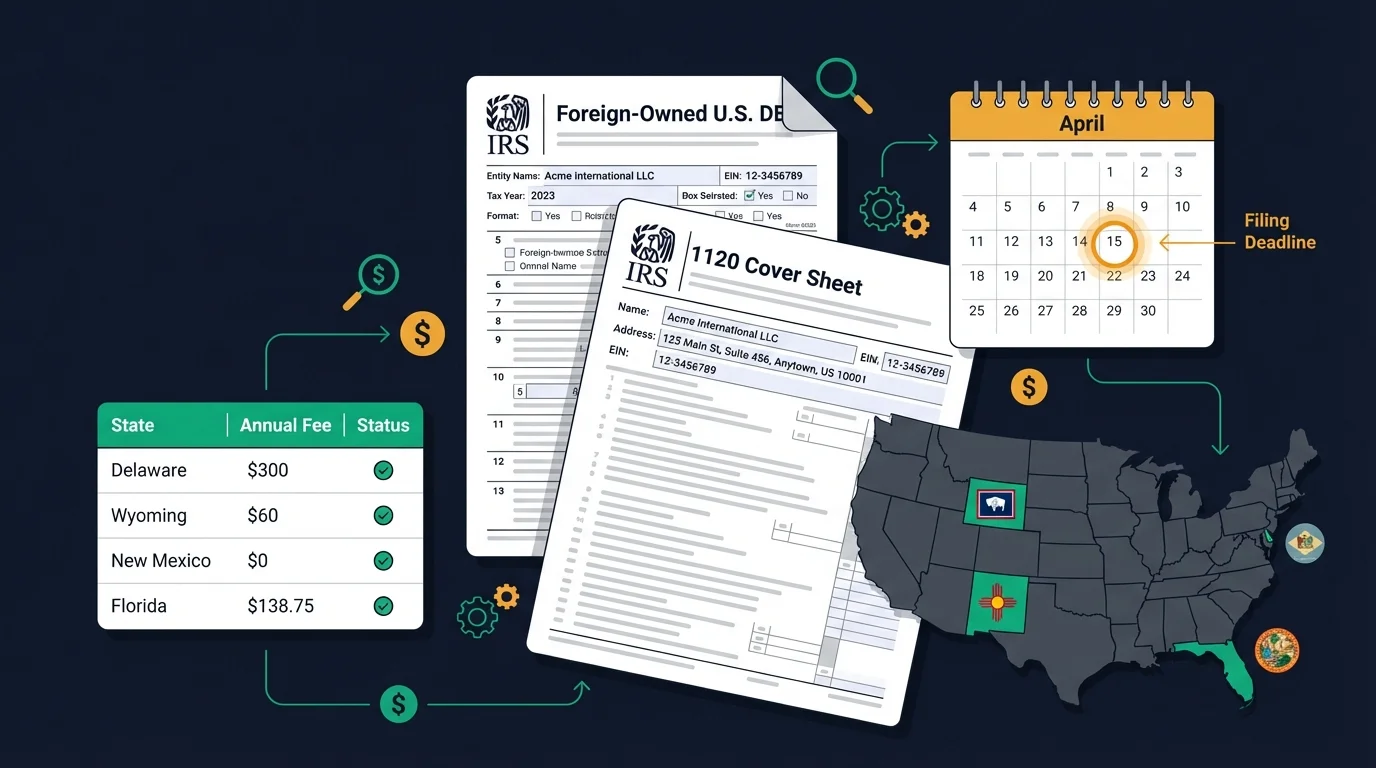
Filing requirements for a non-resident single-member LLC with no US income
You owe zero US tax, but you still have filings. Here's exactly what a non-resident single-member LLC must file, state by state, and what it costs.
If you own a US LLC as a non-resident, have no US-source income, and no US operations, you owe zero federal income tax. But you still have filing obligations.
This guide covers exactly what you need to file at the federal level, what each of the four most popular states (Delaware, Wyoming, New Mexico, and Florida) requires annually, and what it all costs to maintain.
The short version
- No US federal income tax if you’re a non-resident alien with a single-member LLC and no effectively connected income (ECI)
- You must file Form 5472 with a pro forma Form 1120 every year
- The penalty for not filing is $25,000 per form, per year
- State annual fees range from $0 (New Mexico) to $300 (Delaware)
- Total annual maintenance cost: $350-$900, depending on state and whether you file yourself or hire someone
- Paper filing only - e-filing is not available for foreign-owned disregarded entities
Are you actually in this situation?
Before we go further, let’s confirm this article applies to you. You need to meet all four criteria:
- You’re a non-resident alien (NRA). You’re not a US citizen, not a green card holder, and you don’t pass the substantial presence test. If you spent more than 183 days in the US this year, stop here - your situation is different.
- Your LLC has one member - you. If you added a partner, your LLC is taxed as a partnership and files Form 1065 instead. Different rules.
- You have no effectively connected income (ECI). Your business doesn’t operate through a dependent agent in the US, you don’t have a US office, and your income isn’t tied to US-based activities. I explain ECI in detail in my LLC guide.
- Your LLC is treated as a disregarded entity. You haven’t elected to be taxed as a corporation. If you’re not sure, you haven’t - this is the default for single-member LLCs.
If all four apply, your LLC owes zero federal income tax. You still have annual filing requirements, which I’ll cover below.
The federal filing package
Every foreign-owned single-member LLC must file two forms together: Form 5472 and a pro forma Form 1120. Think of the 1120 as the envelope and the 5472 as the letter inside.
Form 5472 - the information return
Form 5472 is an information return. The IRS wants to know your LLC exists and what transactions happened between the LLC and its foreign owner.
One thing to be aware of: the definition of “reportable transaction” is broad. Transferring money from your personal account to your LLC’s bank account counts. Paying yourself from the LLC counts. Even if your LLC had zero revenue and zero clients, funding the LLC’s bank account triggers the filing requirement.
This requirement started in 2017 when the IRS expanded reporting rules to cover foreign-owned disregarded entities (Treasury Decision 9796). Before that, single-member LLCs didn’t need to file. Now they do - regardless of activity level.
You need a separate Form 5472 for each related party with reportable transactions. For most people, that’s just one form - you and your LLC. But if your LLC transacts with other companies you own, each relationship gets its own 5472.
Pro forma Form 1120 - the cover sheet
The pro forma 1120 is not a full corporate tax return. It’s a simplified cover page that the IRS requires as a “parent form” to attach the 5472 to.
What you actually fill in:
- Entity name and address
- EIN
- Date of incorporation
- Items B (employer identification number) and E (date incorporated) on page 1
- Write “Foreign-Owned U.S. DE” across the top of both the 1120 and the 5472
Everything else stays blank. No tax liability is created.
Part V - contributions and distributions
Part V of Form 5472 is where you report capital contributions (money you put into the LLC) and distributions (money you took out).
If you contributed $5,000 to your LLC’s bank account and later withdrew $3,000, those amounts go here. If a transaction doesn’t fit into Parts IV or VI, you check the box in Part V and attach a statement describing it.
Keep descriptions straightforward: “Capital contribution from sole member: $5,000” or “Distribution to sole member: $3,000.”
Deadlines and how to file
Due date: April 15 of the following year (for calendar-year filers, which is almost all single-member LLCs).
Extension: File Form 7004 for an automatic six-month extension, pushing your deadline to October 15. The extension is automatic - you don’t need a reason.
Filing method: Paper only. Foreign-owned disregarded entities cannot e-file the pro forma 1120 with Form 5472. You mail it to:
IRS, 1973 Rulon White Blvd, M/S 6112
Attn: PIN Unit
Ogden, UT 84201
You can also fax it to 855-887-7737. I recommend keeping proof of delivery - certified mail or fax confirmation - because if the IRS claims they never received it, the burden of proof is on you.
State-by-state filing requirements
Your federal obligations are the same regardless of which state your LLC is formed in. State requirements vary by cost and filing schedule.
| Delaware | Wyoming | New Mexico | Florida | |
|---|---|---|---|---|
| Formation fee | $90 | $100 | $50 | $125 |
| Annual state fee | $300 (franchise tax) | $60 (annual report) | $0 | $138.75 (annual report) |
| Filing deadline | June 1 | Anniversary month | None | May 1 |
| State income tax on LLC | None for NRAs | None | None for NRAs | None |
| Privacy | No member disclosure | No member disclosure | No member/manager disclosure | Members disclosed in annual report |
| Registered agent required | Yes | Yes | Yes | Yes |
| RA cost (third-party) | $100-$150/yr | $100-$150/yr | $100-$150/yr | $100-$150/yr |
Delaware
Delaware charges a $300 annual franchise tax for LLCs, due by June 1 every year. There’s also an annual report, but the franchise tax is the real cost. For a dormant LLC with no US income, Delaware is the most expensive of these four states to maintain.
Delaware’s reputation comes from its Court of Chancery and well-developed corporate law. That matters for venture-backed startups with complex governance needs. For a single-member LLC with no US operations, the higher annual cost doesn’t come with a practical advantage over Wyoming or New Mexico.
Wyoming
Wyoming charges $60 per year for its annual report (or a minimum based on assets in Wyoming, which is $60 for most foreign-owned LLCs with no US assets). The report is due during your anniversary month - the month you formed the LLC.
Wyoming offers strong privacy protections (no public disclosure of members), no state income tax, and solid asset protection through its charging order provisions. For most non-resident founders, Wyoming is the best balance of cost, legal protection, and practical utility.
New Mexico
New Mexico has no annual report and no franchise tax. Zero ongoing state fees. This is why New Mexico gets promoted as the cheapest option.
But “cheapest” is misleading. You still need a registered agent, which costs $100-$150 per year. And you still owe the federal Form 5472 filing, which is the same cost regardless of state. New Mexico also offers the strongest privacy - no public disclosure of members or managers.
The trade-off: New Mexico’s LLC statute is less developed than Wyoming’s or Delaware’s. If asset protection matters to you, Wyoming’s charging order protections are stronger.
Florida
Florida charges $138.75 per year for its annual report, due by May 1. Florida has been growing in popularity for LLC formation, partly because of its large Spanish-speaking business community and proximity to Latin American markets.
For non-residents with no US income, Florida doesn’t offer a clear advantage over Wyoming or New Mexico. The annual cost is moderate, but you’re not getting anything extra for it.
Annual maintenance cost
The formation fee is a one-time cost. Your ongoing annual expenses include the registered agent, Form 5472 preparation, and state fees.
| Cost item | DIY | With a filing service |
|---|---|---|
| Registered agent | $100-$150 | Often included |
| Form 5472 + pro forma 1120 preparation | $0 (if you do it yourself) | $200-$500 |
| CPA review (optional but recommended) | $0 | $200-$400 |
| State annual fee | $0-$300 (depends on state) | $0-$300 |
| Total annual cost | $160-$450 | $400-$900 |
So a New Mexico LLC with $0 in state fees still costs around $350/year to maintain once you factor in the registered agent and Form 5472 filing. A Wyoming LLC runs $360-$710/year.
If you’d rather not prepare the Form 5472 yourself, we handle the filing for you.
Need help with your annual Form 5472 filing?
Learn About Our Filing ServicePenalties for not filing
The penalty for failing to file Form 5472 is $25,000 per form, per year. This applies to late filing and incomplete filing (missing required fields). A few things to know:
- If your LLC transacts with two related parties, you need two Forms 5472. Missing both means $50,000 in penalties.
- Penalties apply per year. Three missed years is $75,000 or more.
- The IRS increased this from $10,000 to $25,000 in recent years.
What to do if you missed prior years
There’s no formal amnesty program for missed 5472 filings. In practice, the IRS generally accepts late filings without penalty if you file before they contact you. The standard approach:
- Prepare all missing returns. File Form 5472 and the pro forma 1120 for every year since your LLC was formed (or since the 2017 tax year, when the requirement began - whichever is later).
- Attach a reasonable cause statement. This is a letter explaining why you didn’t file on time. Common reasons that the IRS accepts: you were unaware of the requirement (especially common since this rule only started in 2017), you relied on a tax professional who failed to advise you, or you were unable to obtain the necessary information.
- File everything together. Send all missing years in one package to the Ogden address.
- Keep copies of everything. Certified mail with return receipt. You want proof that you filed voluntarily.
Filing late on your own initiative is treated more favorably than filing after the IRS contacts you.
BOI reporting in 2026
The Corporate Transparency Act (CTA) requires most LLCs to file a Beneficial Ownership Information (BOI) report with FinCEN. This is separate from your IRS filings.
The CTA’s enforcement timeline has changed several times due to legal challenges. As of early 2026, check FinCEN’s BOI page for the current filing status and deadlines.
If BOI reporting is active when you read this: the report discloses who owns and controls your LLC. It’s filed once (not annually) unless your ownership information changes. The filing itself is free through FinCEN’s online portal.
Next steps
If your LLC is current on filings, keep it that way - Form 5472 by April 15 (or October 15 with an extension) and your state’s annual fee.
If you’re behind, file the missing years before the IRS contacts you.
If you’d rather not handle this yourself, we take care of the Form 5472 filing - preparation, review, and submission.
Ready to get your LLC filings sorted?
Get Started
Written by Chris Natterer
Founder of Globalization Guide, helping international entrepreneurs form and manage US companies since 2019.